The Hidden Cost of Dirty HVAC Coils: Why Your Energy Bills Are 30% Higher Than They Should Be
Armchem Store
Dirty HVAC coils can increase energy consumption by 30% or more and most facility managers have no idea it’s happening.
Unlike a broken compressor or refrigerant leak, dirty coils don’t trigger alarms. They silently drain your budget month after month, hiding in plain sight while your energy bills creep steadily upward. This article reveals the true cost of neglected HVAC coils and shows you how to reclaim thousands of dollars annually.
The Direct Energy Cost: Money Evaporating Daily
Your HVAC system works on a simple principle: refrigerant absorbs heat indoors at the evaporator coil, then releases it outdoors at the condenser coil. When coils accumulate even a thin layer of dust or debris, that contamination acts as insulation, preventing efficient heat transfer.
The result? Your system runs longer and works harder to achieve the same temperature, consuming dramatically more electricity. Department of Energy research confirms that dirty condenser coils alone reduce HVAC efficiency by 30% or more. Add contaminated evaporator coils and systems often operate at just 60-65% of designed efficiency.
For a typical 50,000 square foot office building, this translates to approximately $4,200 in wasted energy annually. Larger facilities see proportionally higher waste a 200,000 square foot warehouse could easily waste $15,000-$20,000 per year compensating for dirty coils.
Equipment Lifespan Impact: Accelerated Depreciation
Energy waste is just the beginning. When coils can’t transfer heat efficiently, compressors run longer at higher pressures, dramatically accelerating wear on every component. Bearings, motor windings, contactors, and capacitors all deteriorate faster under continuous heavy load.
Well-maintained HVAC systems routinely achieve 15-20 year lifespans. Systems with chronically dirty coils typically fail at 10-12 years—that’s 3-8 years of lost service life.
Consider a $12,000 rooftop unit. Proper maintenance yielding an 18-year lifespan creates annual depreciation of $667. Dirty coils reducing lifespan to 12 years push annual depreciation to $1,000 a hidden cost of $333 per year per unit. For facilities with ten units, that’s $3,330 annually lost just to accelerated depreciation, completely separate from energy waste.
Hidden Operational Costs: The Ripple Effect
Overworked systems fail more frequently. Blown capacitors, burned contactors, and refrigerant leaks become regular occurrences, each costing $200-$500 in emergency service calls plus productivity disruption.
Dirty coils also create uneven cooling, triggering employee complaints and productivity loss. Studies show knowledge worker productivity declines when temperatures exceed 72-76°F. Retail customers spend less time in uncomfortably warm stores.
Additionally, contaminated evaporator coils become breeding grounds for mold and bacteria, degrading indoor air quality and potentially creating liability exposure.
Signs Your Coils Need Cleaning
Watch for these warning signs: temperature inconsistencies between rooms, systems running constantly without cycling off, rising energy bills without explanation, and visible dust accumulation around vents.
For outdoor condenser coils, remove the protective grille and examine the fins with a flashlight. You should see clean metal with clear spaces between fins. If you see accumulated dirt, leaves, or general grime, cleaning is overdue.
Preventive Maintenance ROI
Professional coil cleaning typically costs $150-$300 per unit per visit. For five rooftop units cleaned quarterly, that’s $3,000-$6,000 annually.
Compare this to the combined costs of neglect: $4,200 in energy waste, $1,665 in accelerated depreciation, and $1,000 in operational costs totaling $6,865 or more. Spending $3,000-$6,000 on prevention to save $6,865 delivers ROI of 15-130%. Few maintenance investments compare.
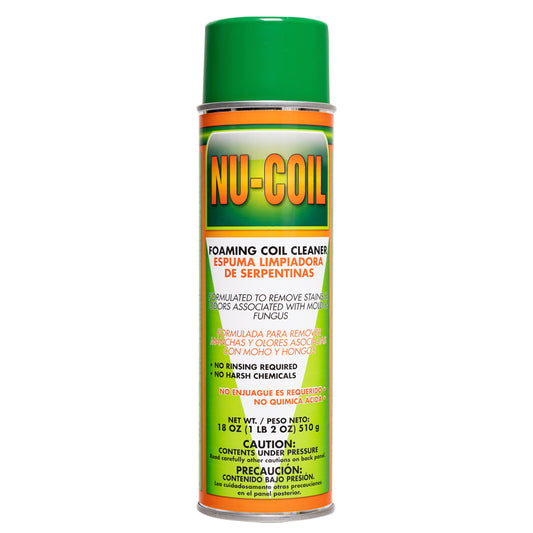
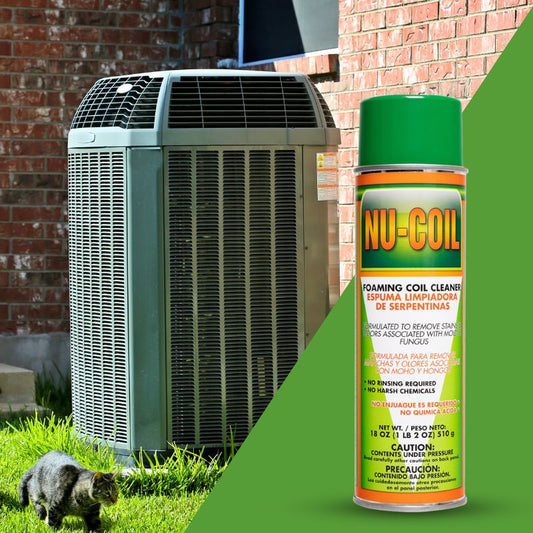
For DIY maintenance, Nu-Coil Foaming Coil Cleaner provides professional results in an accessible format. The foam clings to coil surfaces instead of running off, providing extended dwell time to break down contamination. The expansion action pushes debris from between tightly-spaced fins where spray cleaners can’t reach.
Application is straightforward: turn off power, apply Nu-Coil liberally to coil surfaces, allow 10-15 minutes dwell time, then rinse thoroughly with water from the clean side outward.
DIY vs. Professional Cleaning
Accessible ground-level condenser coils are ideal for DIY maintenance using Nu-Coil. Many facility managers successfully handle quarterly cleaning, reserving professional service for annual deep cleaning.
However, rooftop units requiring ladder access, indoor evaporator coils needing refrigerant system work, and heavily contaminated coils warrant professional service. Always shut off power before cleaning, use safety glasses and chemical-resistant gloves, and follow fall protection protocols for rooftop work.
Stop Paying the Hidden Tax
A typical 50,000 square foot facility wastes nearly $7,000 annually on dirty coils, money that accomplishes nothing except enriching utility companies. Preventing this requires only quarterly attention and professional-grade products like Nu-Coil.
Your action steps: Inspect coils this week, establish a quarterly cleaning schedule, and calculate your current waste to measure improvement.
Ready to reclaim thousands in wasted energy? Nu-Coil delivers professional-grade results in a DIY-friendly format. Shop now at armchem.com/nu-coil.
Your HVAC system is likely your facility’s largest energy consumer. Make sure every dollar delivers actual cooling instead of compensating for dirty coils.